“Those people in Kashmir”
In The Far Field by Madhuri Vijay, a traveling salesman finds himself explaining the fighting in Kashmir at a dinner party in Bangalore:
“Janaab,” Bashir Ahmed said quietly, “you are an intelligent man. Anyone can see that. You have a big business and a big house, and I respect you for that. And you are correct: you don’t know what I think. I have been working and traveling in this country for many years now, and I have seen a lot. But I will tell you this: you are not the only one who believes as you do. There are many others who think the same way, who think that people should be happy with whatever they get, even if it isn’t what they want. And I will also tell you this: as long as people like you believe the things you do, then those people in Kashmir, as you call them, will not go away. No, janaab. They will become more and more in number, and soon other people will join them. Ordinary people like me. And, for your sake, I hope that day doesn’t come, because that is when you will really have something to worry about.”
I’d never heard him speak at such length, except during a story, but the voice he addressed my father in was not the intimate voice of his stories, the one with the dramatic swoops, the repetitions, the one that accompanied the rise and fall of his hands, nor was it the weak and fragmented voice that had told us about the militants in his home. He spoke to us from a great remove, as if he had left the room and was looking down at us from some high place. And even then, young and frightened a child as I was, I felt sure that neither my father nor Bashir Ahmed was talking only about Kashmir. Now, of course, I know that for certain.
Eleven years pass, and when we meet Bashir Ahmed again, he is a broken man confined to his house in Kashmir. He tells the story of the past decade, the time since the dinner party. In hindsight, he seems to say, he was right but also wrong:
“In the beginning, there were just two or three militant groups in this area and they all knew and respected each other, but slowly more and more groups started to form. One group would split into two, under different leaders, and they would spend months fighting each other instead of the army. Some groups were willing to talk with the government, others were not. It became so bad that if you heard gunfire at night, you didn’t even know who was doing the shooting. And for us ordinary people, nothing changed. The fighting had been going on for more than ten years, but the freedom they promised us never came. . . .
And so it went on like that, with the army coming one day and beating up people for not telling them about the militants, and the militants coming the next day and beating up people for talking to the army.” A new, dry note entered Bashir Ahmed’s voice. “Sometimes it seemed like they were playing a game with each other, which they were both enjoying a lot, and the rest of us were just a way to keep the score.”
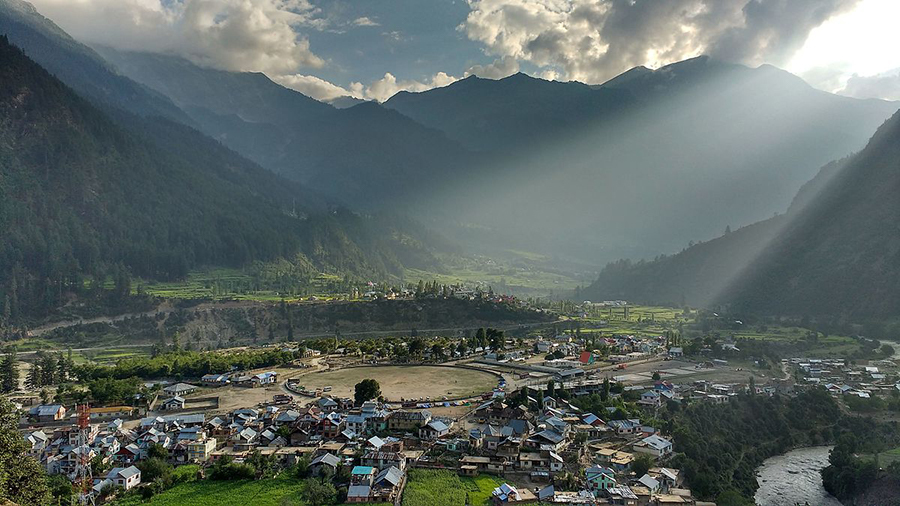
Photo: Gulabgarh in Paddar Valley, in Kishtwar District of Jammu and Kashmir, by Tseringdorjay4, CC BY-SA 4.0
