A language apart
History has made the Sicilian dialect almost a language apart, so great is the legacy of the Greeks, the Arabs, the French, and the Spanish. The dialect is full of marvelous metaphors, strong and vivid and with a rude vitality that has long since been ironed out of Italian. . . . My mother-in-law, for example, an insomniac of many years’ standing, would complain enviously about how easily her husband slept: “Ha il sonno attaccato col laccio—He has sleep tied on with a string,” and in my mind would appear a soft, quilted cloud, like a balloon tied on by string to the bedpost, which at a gentle tug from my father-in-law would slowly descend to envelop him in sleep. . . .
Sicilians will usually laugh at my attempts to use their dialect: they proudly claim that no one who was born off the island can properly pronounce the double d that has taken the place of the Italian double I, as in bedda matre e beramente, “by the beautiful Mother and verily,” a phrase with which a Sicilian protests his sincerity, or in ’adduzzu, “little rooster,” the word Tonino makes me say to prove, to his perpetual amusement, that I am still unable to locate the particular spot between palate and throat from which the tongue must launch the double d.
—Mary Taylor Simeti, On Persephone’s Island: A Sicilian Journal
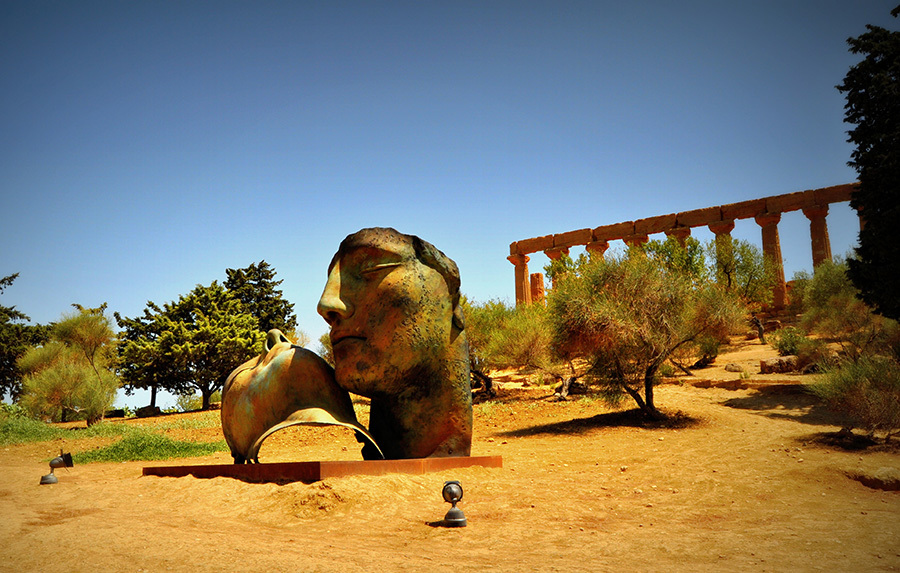
Photo: Sculpture by Igor Mitoraj in Agrigento, Sicily, at the Valley of the Temples, CC BY 2.0, cropped.