Absorbing the scale of the disaster
It was hard for many people, even the highest in the land, to absorb the scale of the disaster which had befallen Allied arms, and which now threatened to overwhelm Britain. Alan Brooke was struck by a Churchillian observation about human nature. The prime minister said that the receptive capacity of a man’s mind was like a three-inch pipe running under a culvert. “When a flood comes the water flows over the culvert whilst the pipe goes on handling its 3 inches. Similarly the human brain will register emotions up to its ‘3 inch limit’ and subsequent additional emotions flow past unregistered.” So it now seemed to Brooke himself, and to a host of others. They perceived that a catastrophe was unfolding, but their hearts could not keep pace with the signals from their brains about its significance. Harold Nicolson wrote in his diary on June 15: “My reason tells me that it will now be almost impossible to beat the Germans, and that the probability is that France will surrender and that we shall be bombed and invaded . . . Yet these probabilities do not fill me with despair. I seem to be impervious both to pleasure and pain. For the moment we are all anaesthetised.”
Another eyewitness, the writer Peter Fleming, then serving as an army staff officer, identified the same emotional confusion: “This period was one of carefree improvisation as far as most civilians were concerned. It was as though the whole country had been invited to a fancy-dress ball and everybody was asking everybody else ‘What are you going as?’ . . . The British, when their ally was pole-axed on their doorstep, became both gayer and more serene than they had been at any time since the overture to Munich struck up in 1937.”
—Max Hastings, Winston’s War: Churchill, 1940–1945
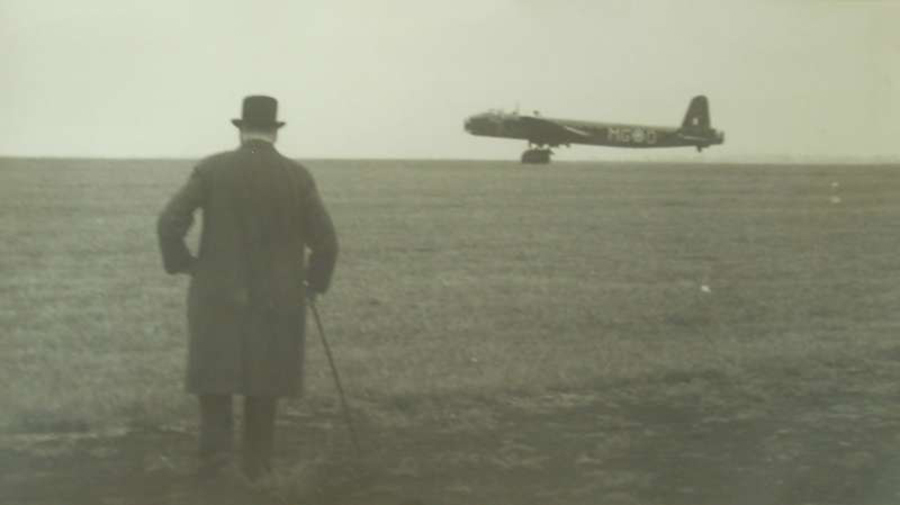
Photo: Churchill walking toward a Stirling bomber in Huntingdonshire, June 6, 1941