The Kaiser’s darlings
If the Kaiser had confined his reading to The Golden Age, Kenneth Grahame’s dreamlike story of English boyhood in a world of cold adults, which he kept on the bed-table of his yacht, it is possible there might have been no world war. He was eclectic, however, and read an American book that appeared in 1890 with the same impact in its realm as the Origin of Species or Das Kapital in theirs. In The Influence of Sea Power on History Admiral Mahan demonstrated that he who controls communications by sea controls his fate; the master of the seas is master of the situation. Instantly an immense vision opened before the impressionable Wilhelm: Germany must be a major power upon the oceans as upon land. The naval building program began, and although it could not overtake England at once, pursued with German intensity it threatened to do so eventually. It challenged the maritime supremacy upon which Britain depended and knowingly created the likelihood of British enmity in war and consequently the use against Germany of Britain’s chief weapon, blockade.
…
As it grew in strength and efficiency, in numbers of trained men and officers, as German designers perfected its gunnery, the armor-piercing power of its shells, its optical devices and range finders, the resistant power of its armor plate, it became too precious to lose. Although ship for ship it approached a match with the British and in gunnery was superior, the Kaiser, who could hark back to no Drakes or Nelsons, could never really believe that German ships and sailors could beat the British. He could not bear to think of his “darlings,” as Bülow called his battleships, shattered by gunfire, smeared with blood or at last, wounded and rudderless, sinking beneath the waves.—Barbara W. Tuchman, The Guns of August
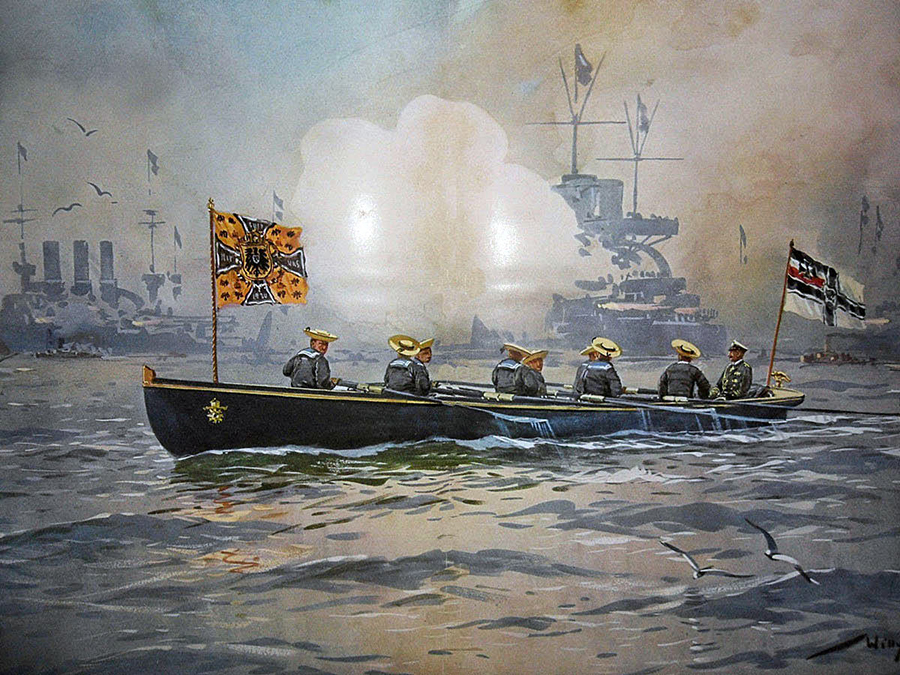
Painting: “Kaiser Wilhelm II Inspecting the Imperial German High Seas Fleet before the First World War” by Willy Stöwer