A microcosm on one page
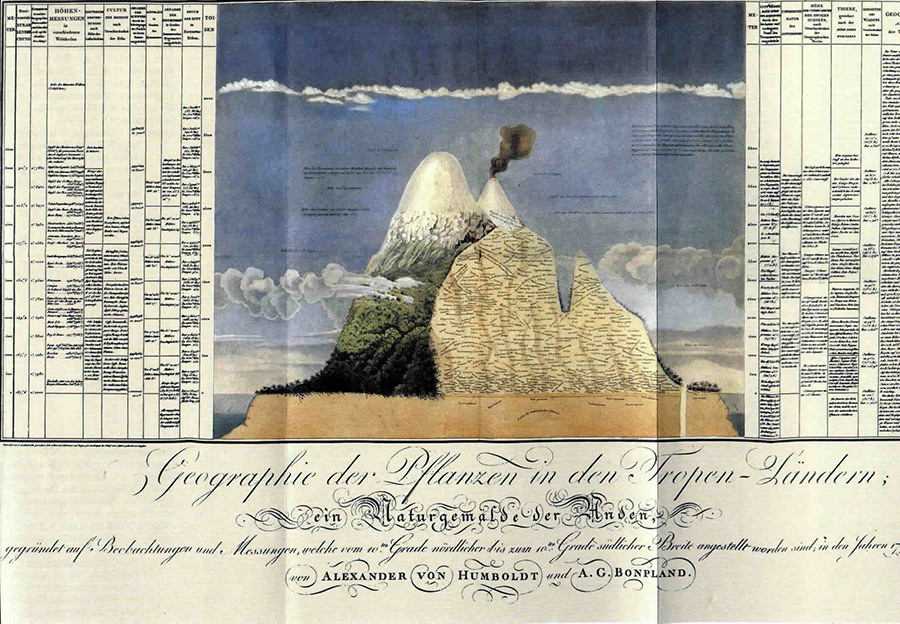
In the Andean foothills, he began to sketch his so-called Naturgemälde—an untranslatable German term than can mean a “painting of nature” but which also implies a sense of unity or wholeness. It was, as Humboldt later explained, a “microcosm on one page.” Unlike the scientists who had previously classified the natural world into tight taxonomic units along a strict hierarchy, filling endless tables with categories, Humboldt now produced a drawing. . . .
Depicting Chimborazo in cross-section, the Naturgemälde strikingly illustrated nature as a web in which everything was connected. On it, Humboldt showed plants distributed according to their altitudes, ranging from subterranean mushroom species to the lichens that grew just below the snow line. At the foot of the mountain was the tropical zone of palms and, further up, the oaks and fern-like shrubs that preferred a more temperate climate. Every plant was placed on the mountain precisely where Humboldt had found them. . . .
This variety and richness, but also the simplicity of the scientific information depicted, was unprecedented. No one before Humboldt had presented such data visually. The Naturgemälde showed for the first time that nature was a global force with corresponding climate zones across continents. Humboldt saw “unity in variety.” Instead of placing plants in their taxonomic categories, he saw vegetation through the lens of climate and location: a radically new idea that still shapes our understanding of ecosystems today.
—Andrea Wulf, The Invention of Nature: Alexander von Humboldt’s New World
Photo: Humboldt’s three-foot by two-foot Naturgemälde from his Essay on the Geography of Plants
