They had the plateau to themselves
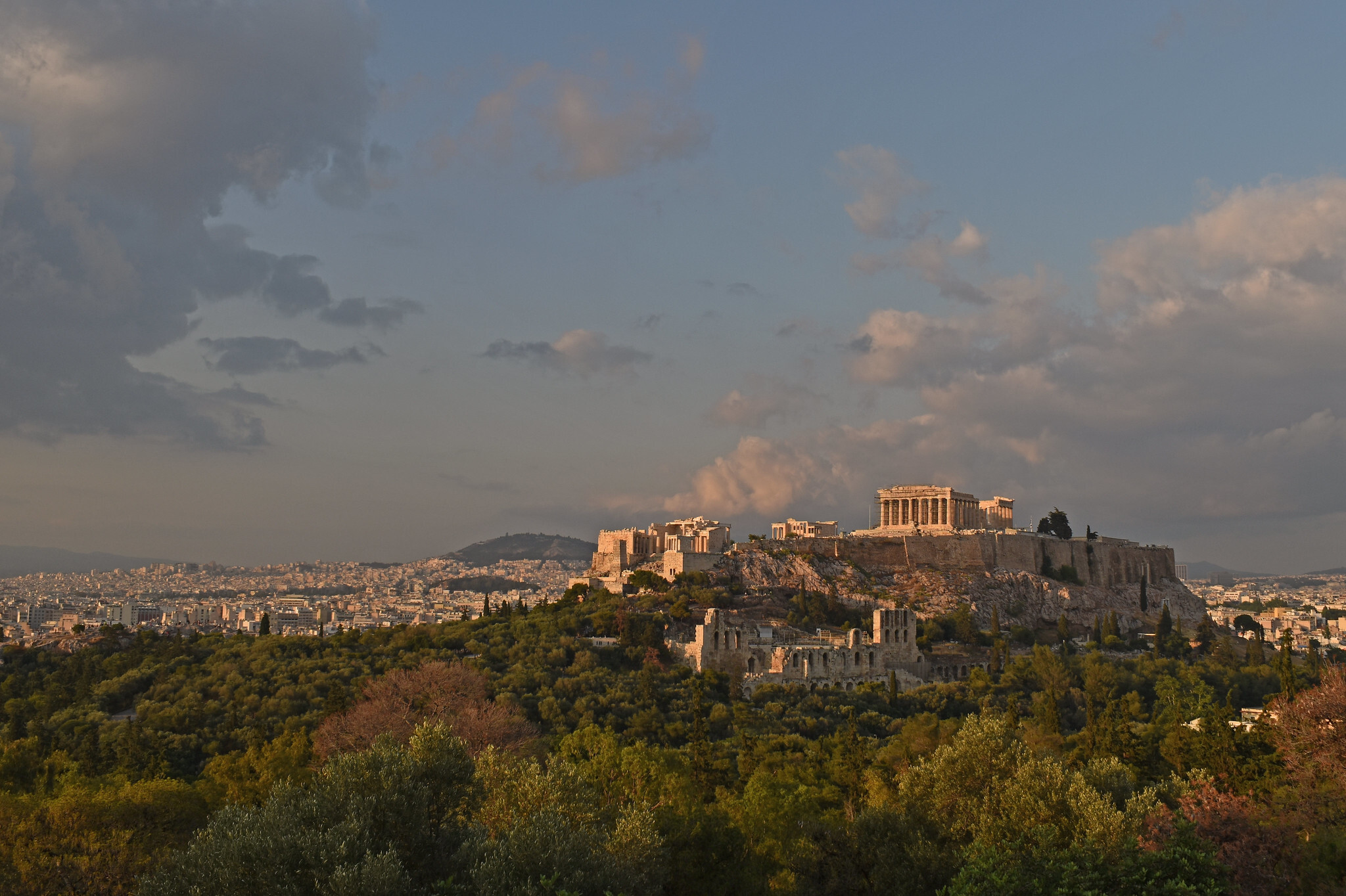
Two scenes I want to remember. Athens in wartime, from Olivia Manning’s Balkan Trilogy:
Since Harriet had last climbed up, a change had come over the rocky flank of the hill. The first rains had been enough to bring the earth to life. Every patch of ground was becoming overlaid with a nap of tiny shoots, so tender that to tread on them was to destroy them.
Seen from this height the green spreading over the Areopagus seemed not a composite of yellow and blue but a primary colour, lucid and elemental.
When they turned the corner and came in sight of the sea, Harriet was struck by the immense structure of cumulus cloud rising out of the Peloponnese. The sky visible between the Plaka roofs had shown only a meaningless patching of grey and white. At this height, the cloud capes of pearl and slate and thunderous purple could be seen swelling upwards like a cosmic explosion, while to the east a luminous undercloud, floating out like a detached lining, lay peach-golden against the blue….
They had the plateau to themselves. The wind blew fresh, singing between the columns, and the distances, sharpened by winter, were deeply coloured. The paving inside the Parthenon was brilliant. Again and again during the last weeks the slabs had been washed by rain and dried by wind until now the whole great floor, reflecting the gold and blue and siver of the sky, seemed to be made of mother-of-pearl.
Harriet wandered about, amazed by the lustre of the marble which held, in its hollows, small pools of rain left by the morning showers, and when she returned to Charles she said: “If you hadn’t brought me, I would never have known it could be like this.”
One chapter later:
When she left the building, she saw Greek soldiers walking along the side road and went to the wall to watch them. They were coming from the station. She had some thought of welcoming them back, but saw at once that they were not looking for welcome. Like the British soldiers she had seen on the first lorries into Athens, these men, shadowy in the twilight, were haggard with defeat. Some were the "walking wounded,” expected to find their own way to hospital; others had their feet wrapped up in rags; all, whether wounded or not, had the livid faces of sick men. They gave an impression of weightlessness.
Their flesh had shrunk from want of food, but that had happened to everyone in Greece. With these men, it was as though their bones had become hollow like the bones of birds. Their uniforms, that shredded like worn-out paper, were dented by their gaunt, bone-sharp shoulders and arms.
One man seeing her watching so closely, crossed to her and said: “Dhos mou psomi,” and as he came near, she could smell the disinfectant on his clothing. She could only guess what he wanted. She opened her hands to show she could give him nothing. He went on without a word.
When they reached the main road, most of them stopped and looked about them in the last forlorn glimmer of the light. Some of them stood bewildered, then one after the other they wandered off as though to them one direction was very like another.
After they had all gone, Harriet still leant against the wall staring into the empty street.
The civilian image of the fighting man was much like that of the war posters that showed the Greeks in fierce, defiant attitudes, exhorting each other up snowbound crags in pursuit of the enemy. Now, she thought, she had seen them for herself, the heroes of Epirus.
Photo: View of the Acropolis by Harshil Shah, CC BY-ND 2.0