The search for order in library science
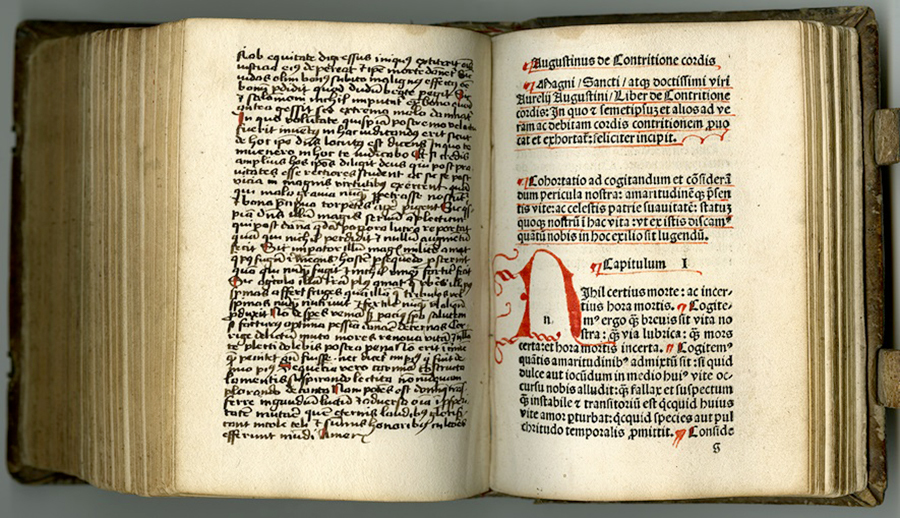
Although we are now encouraged to think of manuscripts and printed books as two distinct and separate entities, this is a cast of thinking entirely foreign to the [first century of print]. Scholars and noble collectors would mix and bind together texts they had acquired according to a highly personal order. These bound volumes might contain manuscripts that had been purchased along with items the owners had copied themselves and texts that had been copied for them. The habit of purchasing and ordering according to personal preference continued after the invention of printing: many volumes from the first century of print mix manuscripts and printed items quite indifferently. Manuscripts were not simply copied from other manuscripts, but sometimes even from early printed editions.
It was said of Frederico de Montefeltro, Duke of Urbino, that he would not allow a single printed book in his library. If this was true, he was certainly an exception. Owners seem not to have cared a great deal whether their book was a manuscript or printed, so long as they obtained the desired text. There was no clear hierarchy of merit between manuscripts and print, particularly as, in the early years, printed texts were so closely modelled on manuscripts in their visual appearance. The extent of this mixing of texts in fifteenth-century book ownership is unfortunately totally obscured by the efforts of over-zealous nineteenth-century librarians, who carefully disbound many of these volumes. The search for order in library science demanded that manuscripts and books should form part of separate collections, and so this crucial piece of evidence of how fifteenth-century owners organized their collections was carefully, lovingly, destroyed.
—Andrew Pettegree, The Book in the Renaissance
Photo: The end of a manuscript on the left-hand page followed by the beginning of a printed text on the right-hand page. Bound together in a single volume circa 1492–1493. From the Bridwell Library, Southern Methodist University.