Lost time
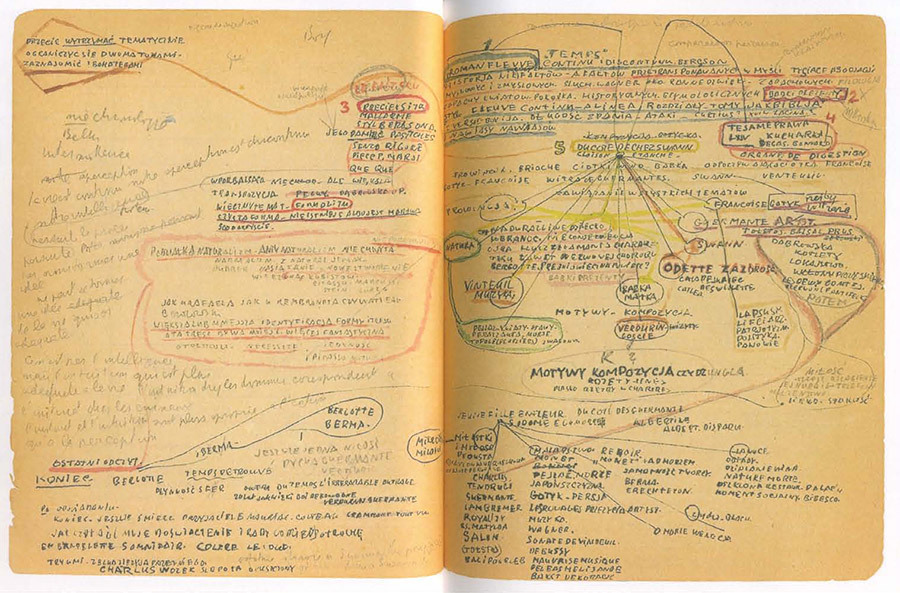
Who, from the outside, would ever conceive of Proust’s stories of the supremely privileged as a subject suitable for an audience of famished, lice-ridden, frostbitten prisoners of war huddled together in bombed-out buildings?
The lectures Czapski gave were unscripted. In preparation, he mapped out a cosmology of Proust… [creating] schematic drawings in a series of prison notebooks. Intended to be used as aide-mémoire, the sheets he covered with information did not represent any kind of text to be spoken; each page was a carefully constructed nesting ground from which ideas might take flight….
The very words temps perdu, lost time, must have resonated with heightened significance. Czapski’s lectures on À la recherche du temps perdu may have reinforced the poignancy of his audience’s sense of loss, but the subtext was a rallying cry for making the most of the time at hand. Presenting Proust as a bulwark against fear and desperation, he shepherded his companions towards the French novelist’s promise of recovery, of le temps retrouvé, towards the hope of finding time again.
—Eric Karpele’s introduction to Lost Time: Lectures on Proust in a Soviet Prison Camp by Józef Czapski
Image: Pages from one of Czapski’s prison notebooks.